
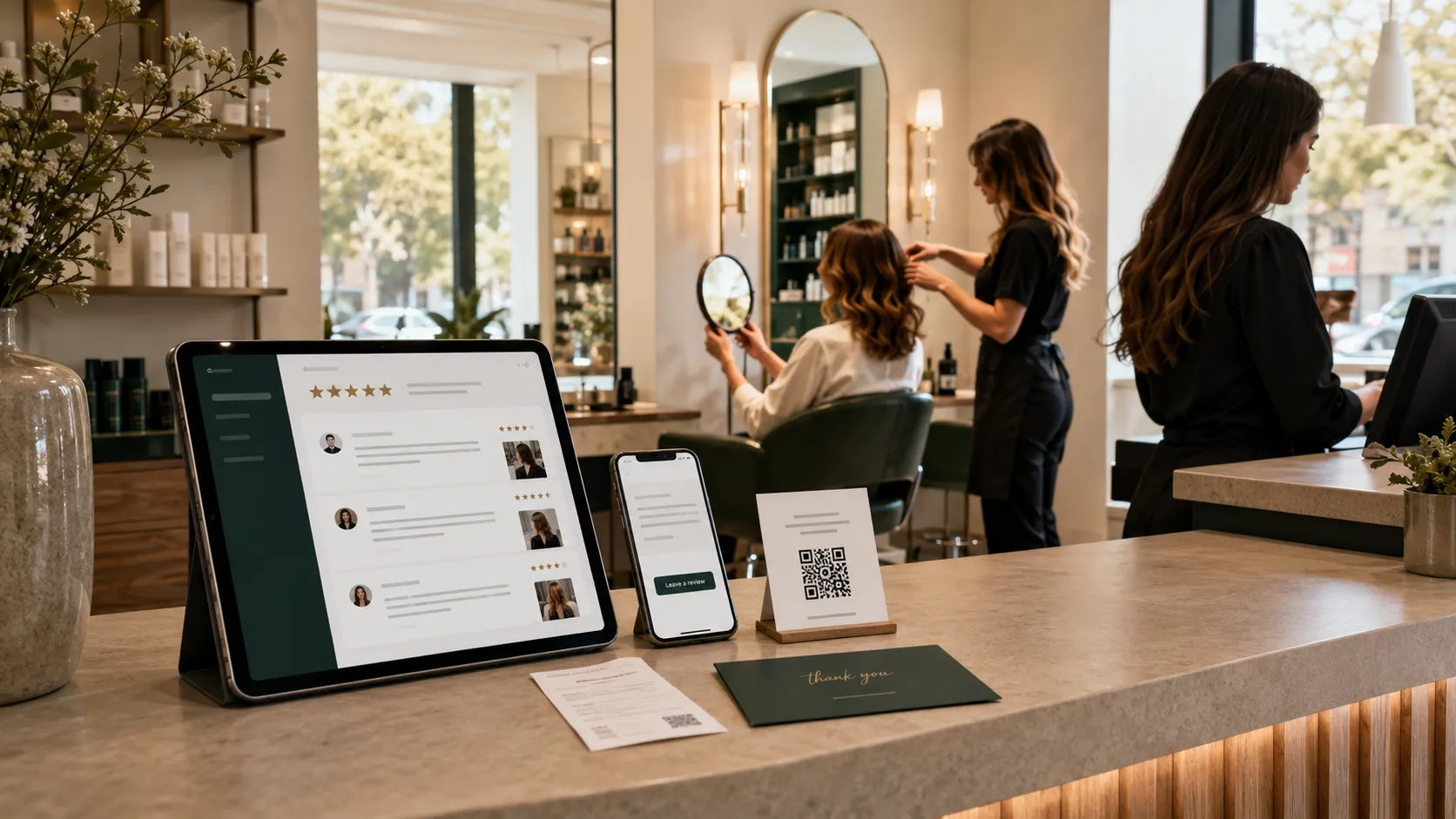

Five-star reviews can make a major difference when someone is choosing between your salon and a nearby competitor. Potential clients may admire your Instagram content or find your website through search, but reviews often provide the reassurance they need before booking.
A strong review profile tells prospective clients that real people have visited your salon, received the services being promoted, and felt satisfied with the experience. Reviews can also highlight the qualities that are difficult to communicate through advertising, such as friendliness, punctuality, attention to detail, cleanliness, consultation quality, and how comfortable clients feel during an appointment.
However, five-star reviews should be earned through a strong client experience and requested through an honest, repeatable system. They should never be purchased, fabricated, or created by staff members pretending to be clients.
Google allows businesses to remind genuine customers to leave reviews through a direct review link or QR code. However, it prohibits offering free or discounted products or services in exchange for posting, changing, or removing a review. The FTC also prohibits fake reviews and incentives that are conditioned on a particular positive or negative sentiment.
Here is how to build a professional review-generation system that can help your salon receive more genuine five-star feedback.
Start With an Experience Worth Reviewing
The most effective review strategy begins before you ask for a review.
Clients are more likely to leave positive feedback when the entire salon experience feels thoughtful, organized, and consistent. Great technical work is essential, but clients may evaluate much more than the final haircut, manicure, facial, or lash set.
They may notice:
- How easy it was to book
- How quickly their enquiry was answered
- Whether the salon was easy to find
- Whether the appointment began on time
- How warmly they were welcomed
- Whether the consultation felt personalized
- How clearly pricing was explained
- Whether the salon appeared clean and professional
- How comfortable they felt during the service
- Whether aftercare instructions were provided
- How the team handled questions or concerns
Review your client journey from the first website visit to the post-appointment follow-up.
A technically excellent service can still receive a disappointing review if the client experienced unclear pricing, a long unexplained delay, or poor communication. On the other hand, thoughtful service recovery can sometimes turn an imperfect appointment into a positive review.
Your review strategy should therefore begin with service standards, not a QR code.
Set Clear Client Experience Standards
Clients should receive a consistent level of care regardless of which team member serves them.
Create simple salon standards covering:
- Greeting clients
- Confirming the requested service
- Conducting consultations
- Explaining price changes
- Managing appointment delays
- Checking comfort during the service
- Presenting the final result
- Providing aftercare
- Recommending maintenance
- Requesting feedback
- Handling complaints
These standards do not need to make every interaction feel scripted. Their purpose is to prevent important parts of the experience from being forgotten.
For example, if a service may cost more because of hair length, product requirements, design complexity, or additional treatment time, explain this before beginning. Clients are less likely to feel surprised at checkout when pricing expectations are set clearly.
The best reviews often mention specific team members and details. Consistent service creates more of those memorable details.
Ask Every Genuine Client for Honest Feedback
Do not wait for clients to leave reviews without being asked.
Many satisfied clients intend to write a review but forget once they return to work, family responsibilities, or other daily activities. A polite reminder makes the process easier.
Ask genuine clients for an honest review rather than specifically demanding a five-star rating.
A suitable request might be:
“Thank you for visiting us today. We hope you enjoyed your appointment. If you have a moment, we would appreciate an honest Google review about your experience.”
This wording is professional because it does not tell the client what rating to leave or pressure them to write only positive feedback.
Your long-term objective is not simply to collect the highest possible star count. It is to build an authentic reputation that reflects the quality of your salon.
Choose the Right Time to Ask
Timing can strongly affect whether a client completes the review.
The best moment is usually when the positive experience is still fresh.
Possible opportunities include:
- After the client sees the final result
- When the client compliments the service
- At checkout
- Shortly after the appointment
- After a successful follow-up
- When a returning client expresses appreciation
- After resolving a concern successfully
Avoid interrupting an emotional or rushed moment.
For example, a client may love the result but need to leave immediately for another appointment. Instead of holding them at reception, send a short review request later that day.
For longer treatments, transformations, or special-event services, a message sent a few hours later may feel more natural than asking while the client is still processing the result.
Test different timing based on your salon and service types.
Create a Direct Google Review Link
The easier the review process is, the more likely a client is to complete it.
Do not ask clients to search for your salon manually, open several pages, and locate the review option themselves.
Create a direct Google review link through your verified Business Profile and use it in your follow-up communications. Google also provides businesses with an option to generate a review link or QR code that customers can use to reach the review form.
Test the link on different mobile devices before sending it to clients.
The link should open the correct salon profile. This is particularly important if your business has:
- Several locations
- Similar nearby business names
- An old profile
- A previous address
- Duplicate listings
- Individual practitioner profiles
Sending clients to the wrong listing can divide your reviews or create confusion.
Use a Review QR Code Inside the Salon
A QR code can make it easy for clients to access your review page before leaving.
Place the code in tasteful locations such as:
- Reception desk
- Checkout area
- Appointment card
- Aftercare card
- Tabletop sign
- Printed receipt
- Service station
- Thank-you card
The design should match your salon branding and clearly explain what the code does.
For example:
“Enjoyed your visit? Scan to share your honest feedback.”
Avoid covering the salon with review signs. One or two carefully positioned prompts usually feel more professional than constant requests throughout the space.
Make sure the QR code is large enough to scan easily and test it after printing.
Send a Post-Appointment SMS Request
SMS can be effective because clients are likely to see the message soon after receiving it.
Keep the message short and personal.
Example:
“Hi Sarah, thank you for visiting Harbor Hair Studio today. We hope you love your new color. We would appreciate your honest feedback: [review link]”
The message should include:
- Client’s name where appropriate
- Salon name
- A short thank-you
- A direct review link
- A simple request for honest feedback
Do not send several review reminders in a short period. One initial message and, where appropriate, one gentle follow-up are usually enough.
Make sure your messaging practices follow applicable consent and communication requirements.
Request Reviews Through Email
Email works well when you want to include more context, particularly for higher-value services or longer client experiences.
A simple review-request email can say:
“Thank you for choosing us for your recent appointment. We hope you enjoyed your experience and are happy with your result. Your feedback helps us improve and helps other local clients understand what to expect. You can share an honest review using the link below.”
Add one clear review button rather than several competing links.
You may also include:
- Aftercare information
- Rebooking recommendation
- Contact details for concerns
- Review link
However, keep the main action clear. An email filled with promotions, referral offers, social links, and booking buttons may distract from the review request.
Train Your Team to Ask Naturally
A review system works better when the entire team understands how and when to use it.
Some salon professionals avoid asking because they worry it will feel uncomfortable. The request becomes easier when it is connected naturally to the conversation.
For example:
“I’m so glad you love the result. We’ll send you a link later today. An honest review would mean a lot to our team.”
Another option:
“Thank you for the lovely feedback. Would you feel comfortable sharing that in a Google review? It helps new clients find us.”
Train team members not to:
- Ask for a guaranteed five-star rating
- Stand over clients while they write
- Tell clients exactly what to say
- Offer rewards in exchange for a Google review
- Use the client’s phone to write the review
- Create reviews on behalf of clients
- Pressure clients who appear uncomfortable
The request should feel like an invitation, not an obligation.
Make Review Requests Part of Your Workflow
Review generation becomes more consistent when it is part of your salon process rather than something staff remember occasionally.
Create a workflow such as:
- Complete the service.
- Confirm that the client is satisfied.
- Address any immediate concern.
- Thank the client at checkout.
- Mark the appointment as completed.
- Send the review request after an appropriate delay.
- Send one reminder only if necessary.
- Respond when the review is published.
Your booking or customer-management software may support automated follow-up messages. Automation can reduce missed opportunities, but the wording should still sound personal and match your salon voice.
Review requests should not be sent to cancelled appointments, no-shows, people who did not receive a service, or customers whose issue is still unresolved.
Do Not Offer Discounts for Google Reviews
A discount, free add-on, loyalty point, giveaway entry, or complimentary service may appear to be a quick way to generate reviews, but it can create serious credibility and policy problems.
Google specifically treats free or discounted products and services offered in exchange for reviews as prohibited fake engagement. Its guidance also prohibits incentives offered to make someone change or remove a review.
Avoid offers such as:
- “Leave a five-star review and receive 10% off”
- “Post a positive review for a free treatment”
- “Show us your review to receive loyalty points”
- “Remove your negative review and we will issue a discount”
- “Enter our giveaway by reviewing us on Google”
You can run a general customer survey, referral program, or loyalty program, but do not make the reward dependent on posting a Google review or expressing a particular positive sentiment.
Never Buy or Create Fake Reviews
Purchased reviews may create a temporary increase in your rating, but they can damage the salon’s reputation and expose the business to platform and regulatory action.
Do not:
- Buy review packages
- Ask employees to pretend to be clients
- Ask friends who have never visited to post reviews
- Create reviews through multiple accounts
- Use AI to invent customer experiences
- Pay a provider that promises guaranteed five-star reviews
- Post negative reviews about competitors
- Reuse testimonials from unrelated customers
The FTC’s Consumer Reviews and Testimonials Rule addresses fake or false reviews, purchasing reviews conditioned on sentiment, certain insider reviews, deceptive review websites, review suppression, and fake social-media indicators. The rule became effective on October 21, 2024.
A smaller number of detailed, authentic reviews is more valuable than a suspicious surge of generic feedback.
Encourage Clients to Write Useful Reviews
You should not dictate the client’s wording, but you can explain that specific feedback is useful.
For example, your request might say:
“If you choose to leave a review, you are welcome to mention the service you received and anything you found helpful about your experience.”
This may encourage clients to discuss:
- The service booked
- Consultation quality
- Team member
- Final result
- Salon atmosphere
- Cleanliness
- Communication
- Booking experience
- Professionalism
- Whether they plan to return
Detailed reviews help potential clients understand what the salon actually does.
A review saying “Great salon” is positive, but a review explaining that the stylist carefully corrected uneven color, communicated pricing clearly, and created an easy maintenance plan is much more persuasive.
Respond to Positive Reviews
Replying to positive reviews shows appreciation and helps strengthen the relationship with the client.
A good response should be warm, specific, and natural.
Example:
“Thank you, Amanda. We are delighted that you enjoyed your balayage appointment with Mia and felt comfortable throughout the consultation. We appreciate your support and look forward to seeing you again.”
Avoid using the same generic response for every client. Repetition can make responses feel automated.
Where appropriate, reference:
- The client’s service
- The team member
- A detail from the review
- Appreciation for the visit
- A welcoming return message
Do not include private information that the reviewer did not publish themselves.
Handle Negative Reviews Professionally
Even a well-managed salon may receive criticism.
Do not panic, argue publicly, or respond while angry. A calm response can demonstrate professionalism to future clients.
A useful response structure is:
- Thank the reviewer for the feedback.
- Acknowledge the concern.
- Express regret that expectations were not met.
- Avoid debating private details publicly.
- Invite the client to contact the salon directly.
- Explain that you want to review the situation.
Example:
“Thank you for sharing your feedback. We are sorry that your recent experience did not meet expectations. We would appreciate the opportunity to review the appointment and discuss your concerns privately. Please contact our salon manager at [contact information].”
Google allows verified businesses to reply publicly to reviews. It also recommends moving sensitive resolution discussions to email or telephone rather than sharing private information in the response.
Do not offer a refund or complimentary service publicly in exchange for deleting or changing the review.
Resolve the actual concern first. If the client later chooses to update the review voluntarily, that should be their decision.
Report Reviews Only When They Violate Policy
A negative review is not automatically removable simply because you disagree with it.
Google generally does not mediate ordinary disagreements between businesses and customers. However, businesses can report reviews that violate platform policies, such as certain spam, harassment, conflicts of interest, or prohibited content.
Before reporting a review:
- Confirm whether the person appears in your records
- Check whether the review refers to another location
- Save relevant internal information
- Review the platform policy
- Respond professionally where appropriate
- Submit a policy-based report rather than an emotional complaint
If the review appears to describe a genuine client disagreement, focus on resolution and a professional public response.
Use Private Feedback to Prevent Negative Reviews
Provide clients with an easy way to raise concerns directly.
This should not be used to prevent unhappy clients from leaving public reviews. Instead, it helps your salon discover and resolve problems before they become larger.
Possible methods include:
- Post-appointment satisfaction message
- Customer-support email
- Short private feedback form
- Manager follow-up
- Clear correction policy
- Direct contact option on receipts or aftercare cards
Ask questions such as:
“Is there anything we could have done to improve your visit?”
When a client identifies a concern, respond promptly. A small issue may become a negative review when the person feels ignored.
However, do not send only satisfied clients to Google while diverting unhappy clients into a private process. Your review request should remain fair and honest.
Monitor Review Patterns
Individual reviews are useful, but patterns can reveal operational problems.
Review feedback regularly and look for repeated comments about:
- Waiting time
- Booking difficulties
- Pricing confusion
- Staff communication
- Cleanliness
- Service consistency
- Appointment availability
- Reception experience
- Result longevity
- Aftercare
- Cancellation handling
Repeated positive themes can also improve your marketing.
For example, if many clients praise your detailed consultations and natural-looking color, those qualities may deserve greater emphasis on your website and advertisements.
If several clients mention delays, the solution may involve scheduling more time between appointments rather than writing better review responses.
Reviews should influence business improvements, not simply your star rating.
Set Realistic Review Goals
Avoid setting a goal such as “get twenty five-star reviews this week” if it encourages staff to pressure clients.
Use process-based goals instead:
- Ask every eligible genuine client for honest feedback
- Send requests within the chosen timeframe
- Respond to every new review
- Review negative feedback weekly
- Track review-request completion
- Improve recurring client complaints
- Add the review link to appointment follow-ups
- Keep the Google Business Profile accurate
A healthy review profile usually develops through steady activity rather than sudden unexplained bursts.
Track useful measures such as:
- Number of review requests sent
- Number of new reviews
- Average rating
- Response rate
- Services mentioned
- Team members mentioned
- Common positive themes
- Common complaints
- New bookings influenced by reviews
Connect Reviews With Your Salon Marketing System
Reviews should not operate separately from the rest of your marketing.
Use genuine client feedback to strengthen:
- Google Business Profile
- Service pages
- Landing pages
- Social media content
- Advertising
- Consultation pages
- Email campaigns
- Team training
Always obtain any necessary permission before using a client’s name, photograph, transformation, or private communication in promotional content.
Your strongest marketing system may look like this:
- A potential client sees a salon advertisement.
- They search for the salon on Google.
- They read recent reviews.
- They visit a relevant service page.
- They book a consultation or appointment.
- They receive a strong client experience.
- They receive an honest review request.
- Their review helps the next potential client make a decision.
Salon owners who need support with review generation, Google Business Profile optimization, advertising, websites, content, and client follow-up can explore SalonHarbor’s salon marketing services.
Build a Reputation That Produces More Bookings
Getting more five-star reviews is not about manipulating ratings. It is about creating a salon experience that clients genuinely want to recommend and making it easy for them to share that experience.
Focus on:
- Consistent service quality
- Clear communication
- Accurate pricing expectations
- Thoughtful consultations
- Simple review links
- Well-timed SMS and email requests
- Natural team scripts
- Honest feedback
- Professional responses
- Fast service recovery
- Regular review monitoring
A strong reputation grows when your operations and marketing support each other.
Salon owners who want a managed review and reputation system can compare SalonHarbor’s pricing plans or request a custom quote based on their current profile, locations, review volume, and growth priorities.